Tuesday, November 5, 2013

Day 4, Kids will be Kids

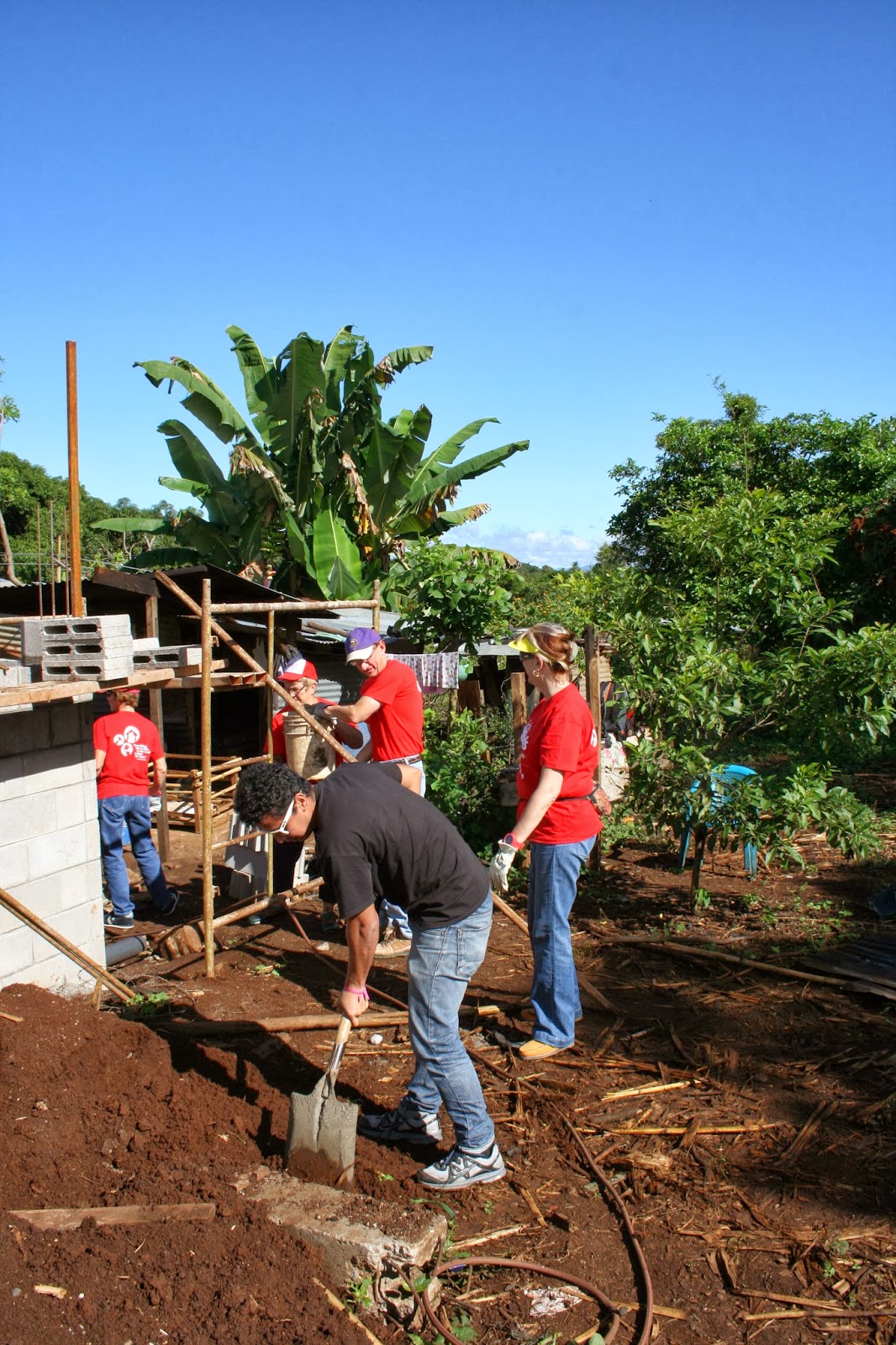
Today again started just like yesterday.  We rode in to the work site, and worked all morning.  The walls of the houses grew higher, and the holes we were digging grew deeper.  The thing that was different about today was our interactions with the local families.  They were more comfortable with us, and we were more comfortable being in their communities, so far away from home.
 
Yes, Anthony actually does work!
 
The work at the sites for the morning session, was more limited, because of our limited time on the sites.  It gave us more time to take in the surrounding area.  The thing that we heard all morning long was the laughter of children playing.  It doesn't matter what you have, you make the best of it.  And these kids could care less where they are.  They have their families, their homes, and they love life.
 

 The children are always so important for change.  With the civil war over, now the country is growing, and continuing to evolve.  Knowing that these communities are slowly getting adequate housing, with a central community center where kids can learn, it give a sense of achieving the goal of development and a better future.

 
After the jobsite, we had lunch (local, homemade food) and we moved out on a bus to an older Thrivent Builds project.  It was pretty incredible that the houses and the community has evolved.  The community looked more established, and the owners took pride in their properties.  They put personal touches on their yards with plants and flowers.

Much more homelike and welcoming

There was also a community center here, where again, we got to play with the children and interact with them at school.  This site is called Villa Esperanza, it is a site that Thrivent Builds has been at in the past, and is complete now.  The kids loved our presence, and we definitely loved the kids.

Two big kids playing

 Guess who worked their way into playing with the kids...
 
We met these children, and started singing a children's song.  Once the song was done, we had another lined up.  When we asked the kids if they wanted to sing another song, they said NO!  So then they were just chased around and tackled!

 
 A special Flory's Flowers....two!

 After winding up the kids and then leaving them to nap... or be wound up with the teacher, we departed to Tazumal.  This was a very unique opportunity to see some of the local Mayan history and structures in El Salvador.  Located in Chalchuapa, it has a large complex with a small museum.  Our local translator and guide was able to give us a great history lesson, while exploring something that is truly unique.
 
Tomorrow will be a very full day of hard work at the job sites, and more time in the community.


Monday, November 4, 2013

Day 3, ants in the pants! Fire ants!

Today started off just like any other day, we all met for breakfast, and then wore our Thrivent Builds shirts and posed for a typical group photo! FUN!


We then jumped on the bus to go to the area that the houses are being built through Habitat called the Gethsemane project.  Basically we pulled off the highway into a typical rural neighborhood.  There are curbs on the roads, but the roads are mud and stone.  If I was on vacation, and happened to make a wrong turn down this road, I would have immediately turned around and went back the other way.  But because of the reason why we are here, to help, we went further into the neighborhood. 

We were dropped off at a new community center where we met the local families that will purchase and live in the Habitat houses that we are building there, four families in total.  The community that we were in, is using the community center for school for younger children, like a pre school to prepare the kids for the regular school, amongst other things.  We were also able to meet members from the community co-op council.  They are using their skills to create jewelry, package coffee, and quilting, to create items to sell, and help their families and communities.

 These are a few of the children that are in the school using the community center.
 
After a brief background of the community and what the locals are working on, we went to the jobsites to do some work.  We have a larger group this year, and we were able to split up into two separate groups, to work on two separate houses.

 
To give you an idea of what we are building, the next pictures can give you an idea of what type of building we are working on.  They are cinderblock houses that consist of a main room, with 2 separate rooms attached to it.  There is a patio on the back, and a bathroom as well.  The total size would be about 10 feet by 15 feet.
 
Most of the work today consisted of getting some sand sifted to use in making the cement for putting up the cinder block walls.  LOTS of digging.  We have to clear some of the land on one of the properties, and digging a hole about 6 feet deep for a septic tank.  It was a lot of use of the shovel today.

The first activity I did today was to clear some logs and random debris from the back of one of the properties.  Within 5 minutes of actual work, I found an anthill.  I quickly moved away from the anthill, so as not to upset the colony.  Well it turns out, they were upset and found my boots.  They then made it up my boot to just over my socks, where they proceeded to bite me.  These bites ended up burning for about 20 minutes or so each.  When the burning bites started getting up my thigh, I started hitting my legs.  The local masons saw this and started laughing at me...but then they told me to start jumping up and down...it didn't really help at all.  But I did end up killing them all, and the rest of the day went well, jut really hot.

Sifting gravel to get sand to mix concrete

 
Flory's Flowers


Setting the cinder blocks for the home


 This following picture is where one of the families that will get the opportunity to move into the new house that we are currently building.  This is one of the best pictures that captures the lifestyle that so many people live in.  Notice in the front yard the pen that is built for the homeowner's baby to play in.  I run out of words to explain what this is really like.
Seeing more about the community that is very typical for most locals to live in, it really gives us all a deeper appreciation for what we all have.  It also gives us a better sense of how we are truly helping this area, the country, and the people here.

Sunday, November 3, 2013

Day 2, heading west, and up and up...and up

Day 2 started with us all getting a much needed night of sleep in some great hotels in El Salvador.  After packing, we all met together and took our bus over to La Resurrection Lutheran Church for their service in the morning.  It is an old building that they are planning to break ground one year from now, to build a brand new place of worship. 


There is so much history that surrounds El Salvador, as well as the church.  As the country developed, the military ran the country up until the 90's when there was a civil war.  Over 30,000 civilians have been wiped out from the 30's until the civil war, with the majority between the 70's and the civil war.

This band was a family that led our music in the worship (in Spanish)

We were able to meet the congregation, and when we said peace be
with you, we met and shook hands with about everyone in the church.
 
As a special bonus, Pastor Mark was asked to be a part of the service in Spanish.
 
After church, we were able to sit down with Pastor Gomez (in all white) and learn loads about how Christians were persecuted and killed for their beliefs over the past several decades.  The church has even lasted through two separate bombings during the civil war.  During this time, Pastor Gomez actually had to go into hiding, because the military/government wanted him killed.  Luckily for all involved, that time is in the past, and the community is working towards a new future.
 
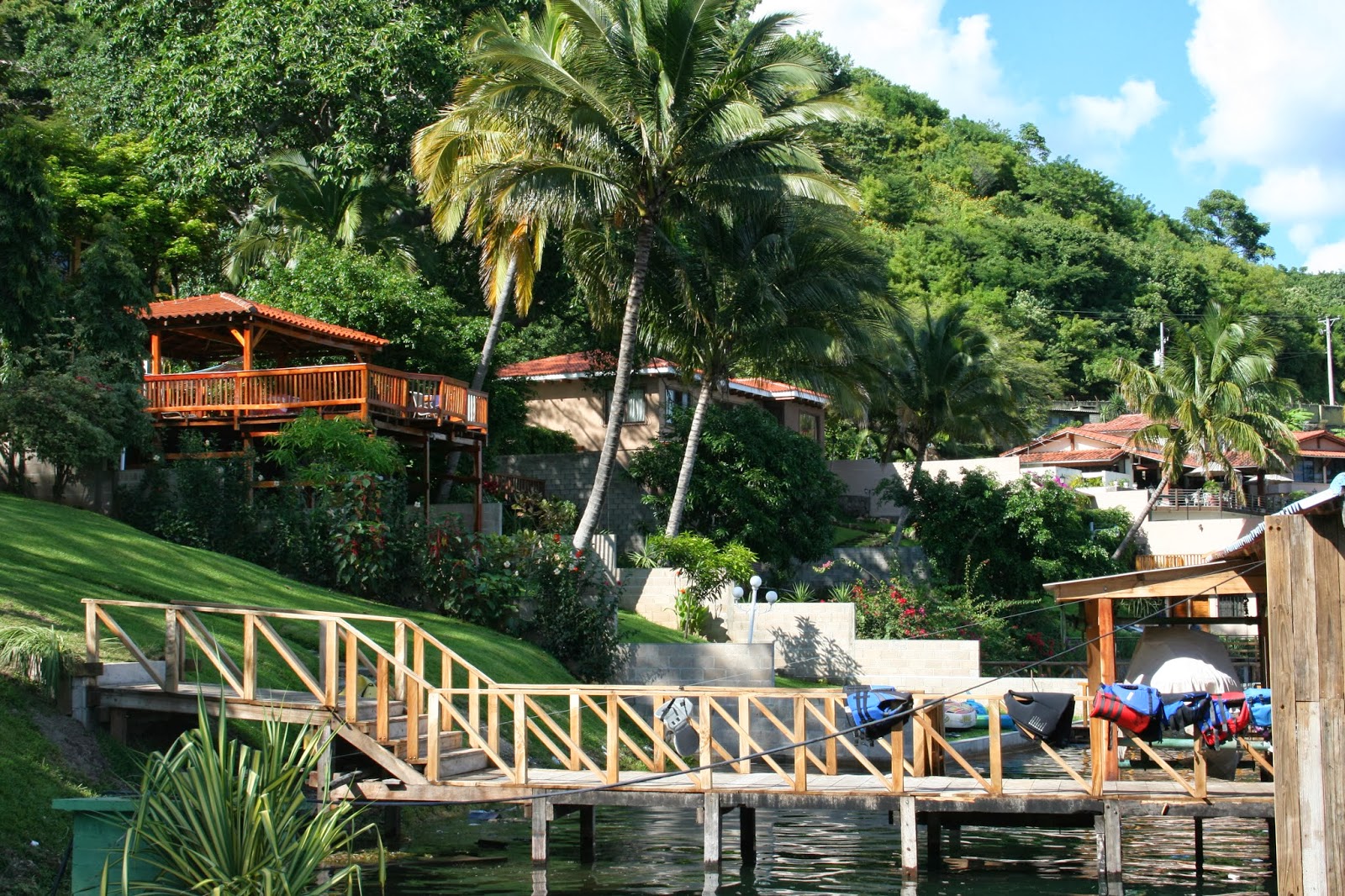
From the church we took about an hour and a half ride to Lago de Coatepeque where we enjoyed our late lunch.  The leaders of habitat El Salvador rented a property for us down here to enjoy some fellowship in a beautiful location.  There are 4 groups of Thrivent Builds with Habitat for Humanity down here for the week, which is more than normal, but great.


Being at this location for the afternoon, really showed the difference in the people here.  There are the wealthy, and the rest of the people.  Minimum wage here is $259 per month, with around 40% of the population that doesn't even earn that.

This lake has formed from an inactive volcano.  When we had asked, no one knows the depth of the lake.  Also, back in 2004, a volcano erupted nearby, and changed the face of the land again, with some of the lava making its way into the lake.

 We were able to grow together as a group, and continued to get to know each other, as we look forward to tomorrow, where we get to work with more locals here, and do some heavy lifting.
 
 
Now that we had some great food prepared for us, and enjoyed such a beautiful day and place, we departed to our final destination for the day, Hotel Alicante, in the department of Ahuachapán.  After arriving safely, we enjoyed a dinner prepared for us, and met as a group for more history.  Jesus, Alex, and Miguel, our interpreters from Habitat, had sat us down after dinner to give us some more history about El Salvador, and how the country has changed over the past century.
 
Now that today is over, some of us are looking forward to tomorrow, and some of us are dreading the day tomorrow, but it is the reason we all came down here.  It will really let us experience the difference between the luxury homes on the lake, and the majority of the people in rural areas, that live in less than adequate living conditions (to our standards, and to most).
 
 
Flory's Flowers


Saturday, November 2, 2013

Day 1, we arrived in El Salvador Safe and Sound

Despite an early morning, and a connecting flight in Miami, we finally arrived in El Salvador.  We were all bright eyed and bushy tailed, and all of this before 5:30AM at O'Hare.  No issues with the flight out, and then we transferred flights out of Miami.  Once we landed then in El Salvador, no one was flagged for a "random" bag search or anything, luck was on our side.

Tired, now in El Salvador, we rode together in a van/bus to San Salvador for a great lunch with a great view.
 

After lunch, we were able to stop in to a local supermarcado, to pick up some snacks, drinks, and anything else we would need before we move into a much more rural area, a few hour ride from San Salvador.  Most of us picked up water and other basic essentials, because we can not drink the water here.  It will most likely prove to be a tough habit to break, especially when brushing our teeth.  It is funny what we take for granted back home.


Mark Flory, the flower pictures have begun


Now that we are all settled in to our hotel rooms, we met up and outlined our schedule for the rest of the week, as well as some ground rules.  Tomorrow we will meet Bishop Gomez, attend church at Resurrection Lutheran, and travel on our long trip to the rural area where we will be working, called Ahuachapán.

For dinner tonight, we ate a traditional San Salvadorian dinner at a place known for Papusas.
 This was what we all had to eat, consisting of... Papusa, Yucca Fritter, Fried Plantain, Tamale, and a mini Enchilada.


Everyone is so very tired from an early start today, all the traveling, and the expected early start tomorrow.

We are all looking forward to seeing what true generosity looks like with the people here, and to share together in a great adventure.

Tuesday, October 29, 2013

Marine Life

El Salvador Sea Turtles

So the bio major in me came alive when I stated sorting through some more information about El Salvador.  Especially looking at the oceans and the marine life on the coast.
Looking at the map, El Salvador's coastline sits on the Pacific Ocean with four species of sea turtles, with hawksbills, olive ridleys, leatherbacks, and greens nesting on its beaches or foraging in its waters. Of particular importance is Jiquilisco Bay, a nesting area for the critically endangered hawksbill, one of only two major beaches in the entire Eastern Pacific. The other is in Nicaragua.

El Salvador Sea Turtle Species


Hawksbill: El Salvador is an important area for the critically endangered Eastern Pacific hawksbill. They nest here between the months of May and October.
 
hawksbill-hatchling-el salvador

Hawksbill turtles are named after their narrow pointed beak.  Their highly colored and patterned shell is the sole source of commercial 'tortoiseshell".  They are usually less than 1m in length, weigh 40-60kg, and are less widely distributed than some other species.  Their numbers have declinde by over 80% durning the last century, with the number of nesting females estimated at 8,000.  The species is classified as Critically Endangered.


Olive Ridley: This species is the most abundant in El Salvador, nesting widely year round on El Salvador's beaches. The peak nesting season for olive ridleys is July-December.
 
 
Olive ridley turtles look very similar to Kemp's ridley turtles, but have a deeper body and slightly up-turned shell edges. They are also slightly heavier, reaching 45kg. Although the species is widely distributed, the number of important breeding sites is very low. The species has yet to recover from centuries of over-exploitation, with the number of nesting females estimated at 800,000. The species is classified as Endangered.


Green: This country is an important foraging area for green sea turtles. They also nest in small numbers here on a handful of beaches between June and December.
 
 
Green turtles are named after the greenish colour of their cartilage and fat. They grow up to 1.5m long and can reach 200kg. Widely distributed in tropical and subtropical waters, the number of nesting females is estimated at 203,000. The species is classified as Endangered, with the Mediterranean population classified as Critically Endangered.

 
Leatherback: This species nests in small numbers on a handful of beaches between the months of October and January.
 
leatherback turtle after laying eggs coming back sea with a black boy looking at her
Leatherback turtles are named after their shell, which is leathery rather than hard like other turtles. They are the largest marine turtle species, typically reaching up to 180cm in length and weighing 500kg, and also one of the most migratory, making both trans-Atlantic and trans-Pacific crossings. Widely distributed in tropical and temperate waters, their numbers have declined precipitously in most parts of the world in the last century. The number of nesting females is currently estimated at 34,000 and the species is classified as Critically Endangered.


Friday, October 18, 2013

Habitat for Humanity in El Salvador

About Habitat For Humanity

Habitat's mission: Habitat for Humanity believes that every man, woman and child should have a decent, safe and affordable place to live. We build and repair houses all over the world using volunteer labor and donations. Our partner families purchase these houses through no-profit, no-interest mortgage loans or innovative financing methods.

Habitat is a nonprofit, ecumencial Christian ministry that builds with people in need regardless of race or religion.

Habitat has more than 1,500 local affiliates in the United States, and more than 70 national organizations around the world.  Together, Habitat has helped to build or repair over 600,000 houses, and serve over 3 million people worldwide!

There are nearly 2 billion people around the world who live in slum housing and more than 100 million are homeless. Habitat helps by building or renovating simple, decent houses in partnership with those in need.

Families left homeless by natural disasters, war and civil unrest often face dire housing situations as they struggle to rebuild their lives. We provide shelter and housing assistance to help these families recover.

(http://www.habitat.org/how/about_us.aspx)

Habitat for Humanity in El Salvador

Habitat for Humanity El Salvador built its first 29 houses in 1992, in the department of Santa Ana. Since then, much program renovation and organizational growth have taken place.
This year, 996 families have been served in El Salvador alone.

After being struck by recent natural disasters, the housing need increased rapidly in El Salvador, both in urban and rural areas. Of the total number of houses affected, 60 percent corresponded to homes with an income of up to two minimum wages, and the remaining 40 percent are households with incomes greater than two minimum wages.

El Salvador is still in the process of rebuilding. According to data provided by the Vice Ministry of Housing, the country’s current qualitative and quantitative deficit totals 630,000 houses, or 51 percent of the total population.

Local governments, state institutions, non-governmental organizations and international organizations have made great efforts to respond to the housing needs of affected families. Support from these institutions concentrate on the most affected zones.

Through the work carried out by its affiliate branches, Habitat El Salvador has reached both sectors, concentrating its efforts on providing support to those families in need of adequate housing, without discrimination.

*One monthly minimum wage in El Salvador is US$144, so a family earning two minimum wages would have a monthly household income of US$288.

(http://www.habitat.org/where-we-build/el-salvador)


Thrivent Builds in El Salvador Community

Thrivent Financial's Mission & Vision :

The Thrivent Way

We are a faith-based membership organization.
Our purpose is to strengthen Christian communities
by helping members be wise with money and
inspiring them to live generously.
We succeed when our members and their communities thrive.
We value our relationships, so we will
be trustworthy in character and competence,
we will treat our members as owners and we will
live balanced and generous lives.

(http://www.thriventbuilds.com/partnership/thrivent/mission.html)


This project focuses on housing, land tenure, and volunteer mobilization and partners with Thrivent Financial for Lutherans to improve the quality of life of low-income, landless Salvadoran families by building 75 homes, using Thrivent and local volunteers.

Part of Thrivent Financial’s mission as a faith-based membership organization is caring for others. Participating in this program with Habitat is a prime example of this mission in action.

Thursday, October 17, 2013

T Minus 15 days - A quick geography lesson

This is where we will be travelling to on Nov 2nd. As you can see, El Salvador shares borders with Guatemala and Honduras. It is the only Central American country that does not have a Caribbean coastline.
 
 
El Salvador is divided into 14 departments. We will most likely work in the department of San Salvador which is where the capital is located.
 
 
I hope that this short geography lesson helps you to get a good idea of where we will be during our trip week. El Salvador is the smallest country in Central America, but from what I hear about others that have been there before, the poeple have some of the biggest hearts.
 
Team, I look forward to traveling and working with you. And to all of our followers: get ready to join us for the experience of a lifetime!
 
Please leave comments or questions below; if there is any information in particular you would like shared with the team via this blog, please let me know.